Eat With Your Eyes First: The Psychology of Plating Your Food
- travisjkamper

- Aug 19
- 6 min read

When we talk about managing our weight, we usually talk about what we eat: calories, protein, carbohydrates, fats, vegetables, portion sizes.
But there is another part of eating that gets surprisingly little attention:
What does your food look like before you eat it?
Your brain doesn't wait for food to reach your stomach before it starts evaluating a meal. Long before the first bite, your eyes are already taking in the size of the portion, how full the plate appears, the colors of the food, how it is arranged, and even the plate itself.
That means good nutrition isn't only about cooking the right amount of food.
It's also about presenting that food in a way that makes a reasonable portion feel like a satisfying meal.

Rule #1: Plate Your Food Before You Sit Down
One of the simplest changes you can make is to stop putting large serving dishes in the middle of the table.
Family-style dining may be wonderful socially, but from a portion-control standpoint, it creates an environment where additional food is constantly available.
You finish your chicken.
There's more chicken sitting three feet away.
You finish the potatoes.
The bowl is still right there.
"I'll just have a little more."
The problem is that the decision to eat another serving doesn't necessarily begin with physical hunger. Sometimes it begins simply because the food is visible, available and easy to reach.
Research on self-serving supports the broader idea that our serving environment influences how much food ends up on our plates. In one experiment involving a family-style pasta meal, participants serving themselves from a larger communal bowl served substantially more food than participants using a smaller serving bowl.
Instead, try something simple:
Prepare the meal. Plate everyone's food in the kitchen. Put the remaining food away. Then sit down and eat.
Now there is a defined beginning and end to your meal.
If you finish your plate and are genuinely still hungry, you can absolutely have more. But getting another portion now requires a conscious decision rather than simply reaching toward the bowl sitting in front of you.
That tiny bit of friction can be useful.
The goal isn't to tell yourself, "I can't have seconds."
It's to give your body enough time to answer a much better question:
"Do I actually want seconds?"
Make a Reasonable Portion Look Like a Great Meal
Now that we're plating the food, don't just throw it onto the plate.
Make it look good.
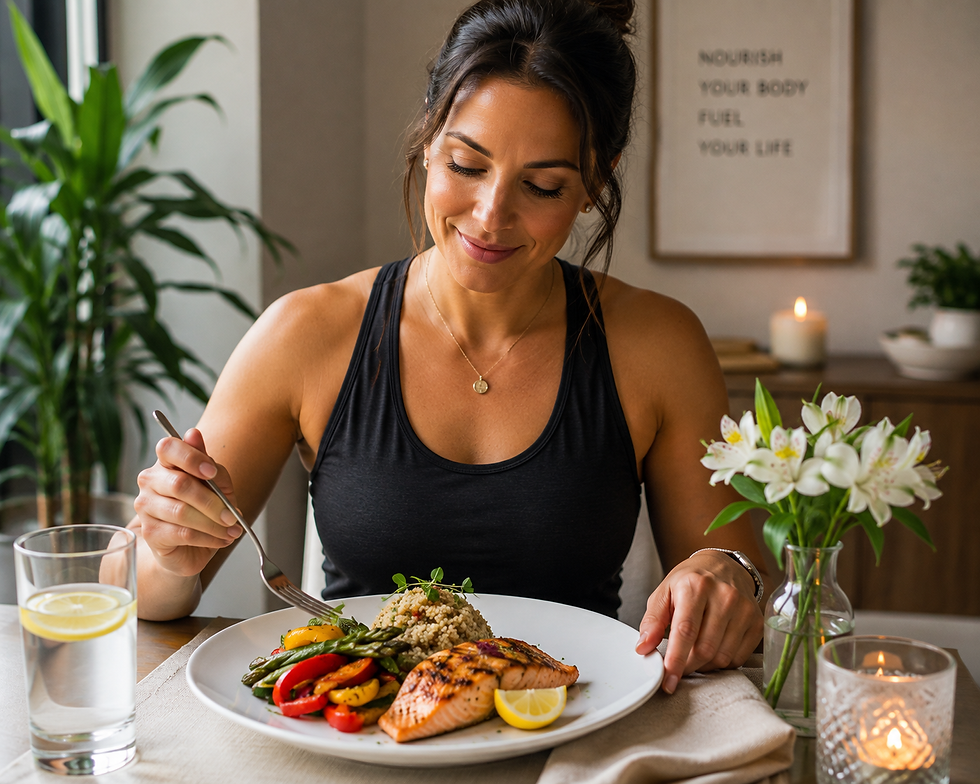
Arrange your protein intentionally. Give your vegetables some space. Keep foods from becoming one giant pile. Use different colors and textures. Wipe that random streak of sauce off the edge of the plate.
You aren't being fancy.
You're using psychology.
Researchers have served people essentially the same food arranged in different ways and found that people actually reported enjoying the food more when it was presented more attractively. Other research has found neatly presented food is liked more than the same food presented messily.
Think about what happens at a good restaurant.
The chef doesn't throw a piece of salmon onto a plate, dump vegetables beside it and send it out.
The food is presented.
That presentation communicates something before you've tasted anything:
This is going to be good.
You can create some of that same experience at home.
And that can be especially valuable when you're trying to change your nutrition. A healthy dinner doesn't need to look like punishment.
Make your healthy food look like food you're excited to eat.

And Please... Don't Forget the Garnish
A garnish might seem pointless nutritionally.
A little parsley isn't going to change your metabolism.
But it can change the experience of the meal.
Add chopped herbs to your chicken. Put cilantro over your tacos. Add green onion to your rice bowl. Sprinkle paprika over roasted potatoes. Add a lime wedge beside grilled fish. Finish a plate with something fresh and colorful.
Research into food presentation suggests that visual information from garnishes can influence the sensory impression and appeal of the main dish.
Again, we're not adding garnish because parsley burns calories.
We're adding it because eating is a sensory experience.
When a smaller, appropriately portioned meal looks colorful, intentional and complete, it can feel more satisfying than exactly the same amount of food dumped onto a plate.
Your Plate Is Playing Tricks on You
Now let's talk about the actual plate.
Imagine putting a normal portion of chicken, potatoes and vegetables in the center of a gigantic 14-inch dinner plate.
It can look tiny.
Your eyes see all that empty space surrounding the food, and suddenly a perfectly reasonable portion doesn't feel very substantial.
So what do you do?
You add a little more chicken.
A few more potatoes.
Maybe another spoonful of something else.
Not necessarily because your body needed it.
Because the plate looked empty.
Now put that same meal on a 9-inch plate.
Suddenly the plate looks abundant.
Same food.
Same calories.
Very different visual experience.
Research on this effect isn't perfectly uniform. Some controlled studies have found little or no difference in actual consumption when the amount of food is fixed. However, a large meta-analysis found that dishware size can influence how much people serve themselves, with larger plates and containers tending to encourage larger self-served portions.
That's the important distinction.
A big plate doesn't magically make you hungry. It can change what looks like a "normal" amount of food when you're deciding how much to serve.
The Goldilocks Plate
So should we eat dinner from a tiny saucer?
Probably not.
We're looking for the Goldilocks Plate:
Not too big. Not too small. Just right.
For most meals, an approximately 8–10 inch plate is a practical target.
A very large 12–14 inch plate creates a lot of visual real estate. If you're self-serving, filling that space can quietly turn a reasonable meal into an oversized one.
But don't take the strategy to the opposite extreme.
Put dinner on a ridiculously tiny plate and your brain isn't stupid.
You'll look at it and think:
"That's not dinner."
And now you're already planning your second plate before you've finished your first.
The goal isn't to fool yourself with miniature dishes.
The goal is to choose a plate where an appropriate amount of food looks abundant, complete and satisfying.
Build a Plate You Want to Eat
Once you've chosen the right plate, think about composition.
Instead of piling everything in the middle, give the meal some structure.
Let colorful vegetables take up meaningful visual space. Give your protein a defined place on the plate. Add your carbohydrate intentionally rather than pouring it into whatever space remains. Use height occasionally—placing sliced chicken partially over vegetables, for example, can make a modest amount of food look more substantial.
Then add your finishing touches.
Fresh herbs.
A squeeze of citrus.
Pepper.
A sprinkle of seasoning.
A little sauce placed intentionally rather than drowning everything in it.
You're creating visual abundance without necessarily creating caloric abundance.
That's a powerful distinction.
Stop Treating Healthy Eating Like a Diet
This may be the most important part.
If every meal associated with weight loss looks like a sad piece of chicken next to three pieces of broccoli on a giant white plate, eventually you're going to get tired of "dieting."
So don't make diet food.
Make beautiful food that happens to support your goals.
Use real plates.
Use seasoning.
Use color.
Use garnish.
Sit down.
Enjoy it.
Food presentation isn't a substitute for energy balance. A beautifully arranged 1,500-calorie meal is still a 1,500-calorie meal.
But successful nutrition isn't only about knowing how calories work.
It's also about creating an environment that makes appropriate portions easier to choose and more enjoyable to eat.
Your New Dinner Routine
Try this tonight:
Choose an 8–10 inch plate.
Plate your entire meal in the kitchen.
Put the remaining food away instead of serving family style.
Arrange the food intentionally.
Add color and a simple garnish.
Sit down and enjoy the plate you created.
Finish it before deciding whether you actually need more.
If you're still physically hungry afterward, have some more.
There is nothing magical about eating exactly one plate of food.
The objective is simply to make the second serving a decision instead of a reflex.
Because sustainable nutrition isn't always about having more discipline.
Sometimes it's about designing your environment so that the better choice becomes the easier choice.
And occasionally, something as simple as changing the plate can help you do exactly that.
Recommended Reading
Zellner et al. — It Tastes as Good as It Looks! The Effect of Food Presentation on Liking for the Flavor of Food — Research showing that attractive plating can improve how much diners report liking the same foods. Read on PubMed
Zellner et al. — Neatness Counts: How Plating Affects Liking for the Taste of Food — Research examining how neat versus messy food presentation changes perceptions of the meal. Read on PubMed
Holden, Zlatevska & Dubelaar — Whether Smaller Plates Reduce Consumption Depends on Who's Serving and Who's Looking — A meta-analysis exploring when plate and container size influences self-serving and consumption. Read the study
Kokaji & Nakatani — With a Hint of Sudachi: Food Plating Can Facilitate the Fondness of Food — Research examining visual presentation and the role of garnish in food perception. Read the study
van Kleef et al. — Serving Bowl Selection Biases the Amount of Food Served — An experiment examining how serving-bowl size influenced portions during a family-style pasta meal. Read on PubMed


Comments